Covering old grey permanent eyebrows: what is actually possible
Old grey or sooty permanent makeup can sometimes be made wearable again. It cannot be made to disappear — and it is not covered over. It is corrected. That distinction is the whole method. The grey is still in the skin, and when the new work fades — which it will — it becomes visible again. This is management, not removal, and it is a process spread over months rather than a single appointment.
Corrected, not covered
Covering is the obvious instinct and the wrong one. To hide a dark deposit you have to put something opaque on top of it, and opacity is density. The brow then carries both the old pigment and the layer added to conceal it, so it reads heavier and more intense than it did before — and it stays that way.
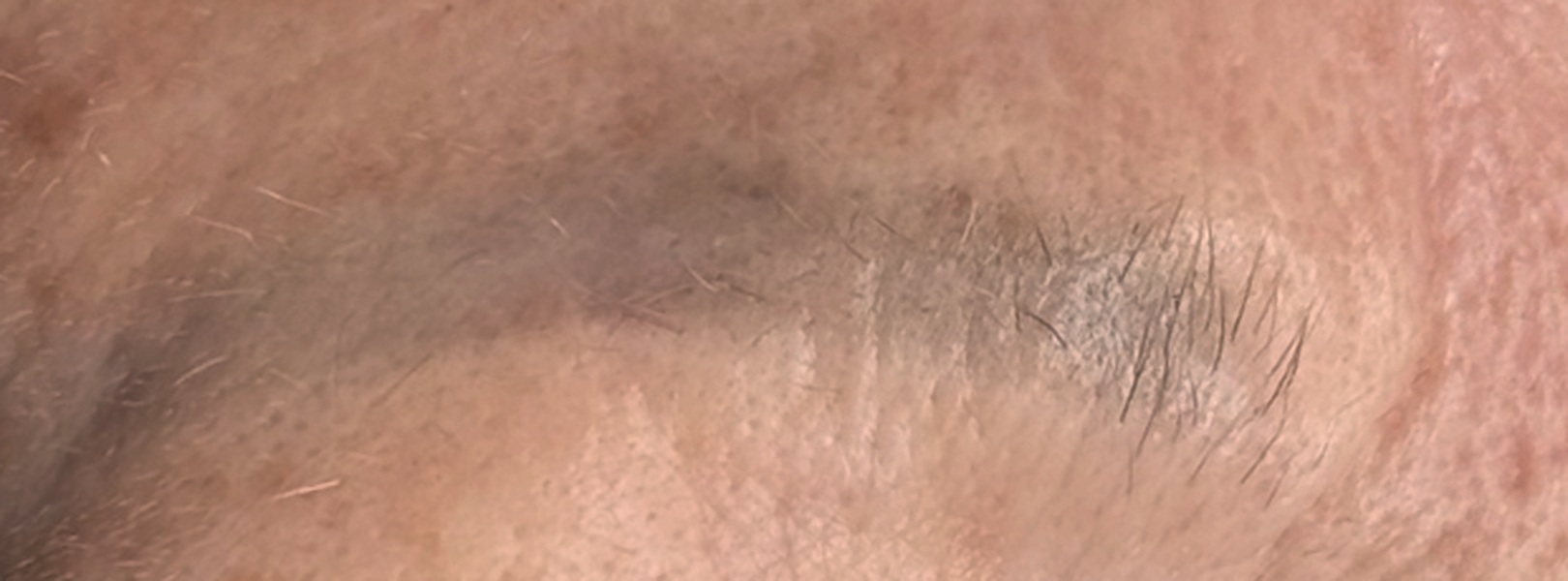
We do implant pigment — that part is the same. The difference is in how it behaves once it is in the skin. A conventional opaque corrector is built to hide: it blocks light, so the old work is still there, now seen through a dense pale layer. What we use stays light-transmitting and works with what is already in the skin: it subtracts the cold from it, so the brow reads warm brown again rather than grey. The old pigment has not gone anywhere; it simply no longer sets the colour.
It is also what makes the next stage possible. A brow that has gone translucent has room for hair to be placed over it. A brow that has been covered has none: it is a solid field, and anything drawn on it disappears into the block.
One honest limit, said here as it is said in the studio: pigment adds to what is in the skin. It does not lighten it and it does not even it out. Where the old deposit sat heaviest it will still read deeper than the rest. That is how this work behaves, and it is what we expect.
Not every old brow can be corrected
New hairstrokes need negative space: untouched skin, between and around the old pigment, where hair can actually be placed. Where the previous work is a dense solid block, there is nowhere for hair to go and correction will not solve it — removal has to come first. This can only be judged by looking at the skin, never from a photograph.
Why we do not use conventional correctors
The objection is not the colour. It is the composition.
Conventional correctors are built on titanium dioxide and on lake pigments, with reds that shift over time. Each of those is a problem in its own right.
Titanium dioxide
It is opaque, and it is the most durable thing in the formula — the component most resistant to being metabolised. So it does not fade the way the rest fades: the warm tones around it go first and the white stays, which is why these corrections drift towards grey-white translucency and frosty highlights after a few years. Because it is added on top of the old deposit rather than instead of it, the brow ends up denser than it was before the correction.
And it does not come out with laser. Titanium dioxide is not removed by it: worked on, it only turns yellower. Worse, it screens the black underneath, so the original work cannot be reached either. A brow corrected this way has, in practice, been closed to removal — the old pigment is still in the skin, with a layer in front of it that the laser cannot clear.
That is the part nobody is told at the time. A correction is supposed to leave options open. An opaque one takes them away.
Lakes and unstable reds
They do not hold their tone. The correction that looked right at eight weeks turns violet or muddy after a year or two, and by then it is sitting on top of the original grey rather than instead of it.
The process
- One — correction. Then eight weeks, untouched. What matters is not how it looks the next day but how it heals.
- Two — assessment. If the correction has healed as hoped and needs no further pass, hairstrokes can begin. If it has not, the correction is repeated and the eight weeks start again.
- Three — hairstrokes, often with a further correction in the same session. In the case shown here, both were done together.
- Four — another eight weeks, then assessed again. A further correction may still be needed.
Each stage is decided on what the skin has actually done, not on a plan made in advance. Anyone promising a fixed number of sessions before seeing how the first one heals is guessing.
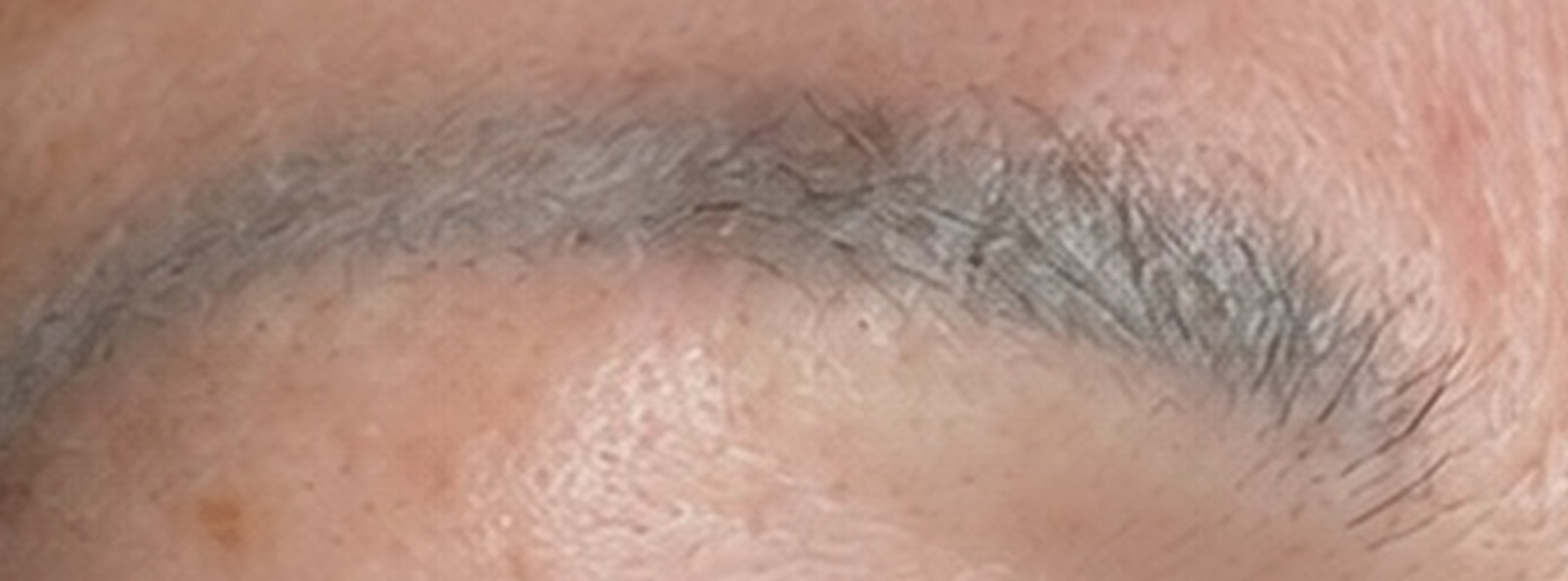
BEFORE
EIGHT WEEKS AFTER THE CORRECTION
AFTER THE HAIRSTROKES
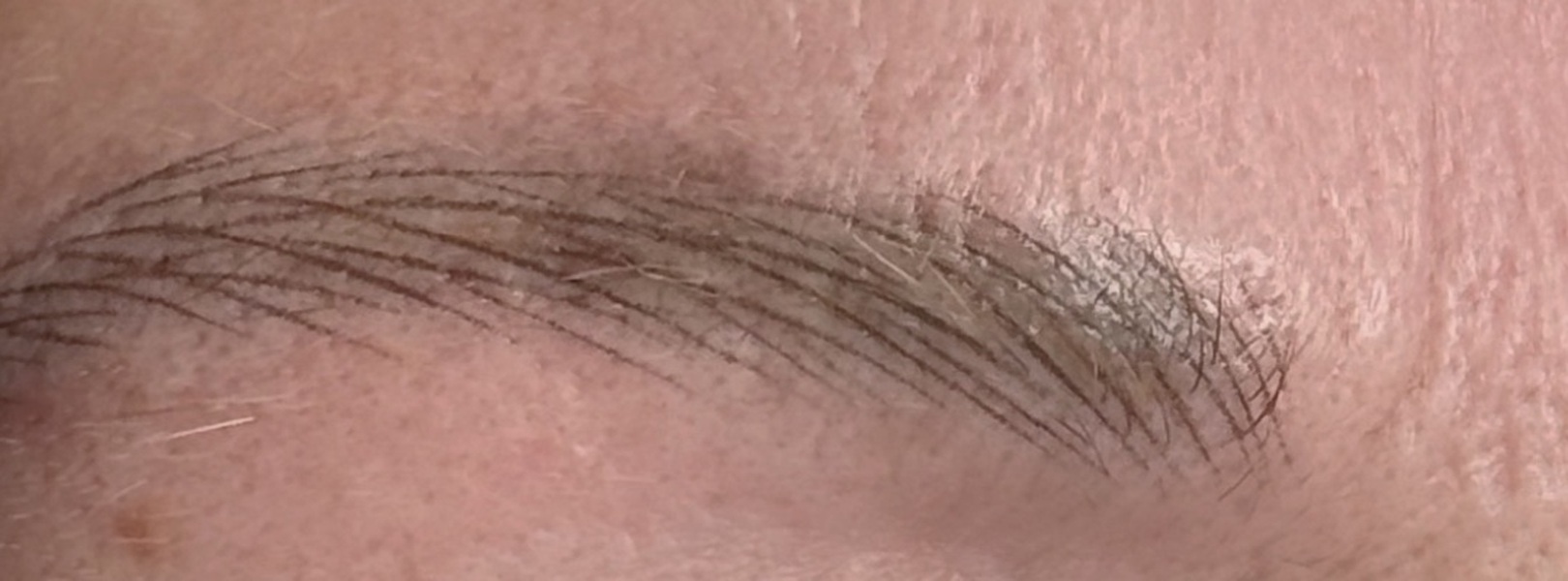
Same brow, same framing, three stages across more than four months.
Questions we are asked
- Can old grey or blue-grey permanent eyebrows be corrected?
- Sometimes. It depends on how much untouched skin is left between the old strokes. A dense solid block cannot be covered with hair — there is nowhere to put it.
- Is the old pigment covered up?
- Not covered — corrected. Pigment is implanted, but it stays light-transmitting instead of blocking the light, and it takes the cold out of the old deposit rather than hiding it behind an opaque layer. The old work is still in the skin; it just no longer decides the colour. And because the new layer stays translucent, there is still room to place hair over it.
- Will the grey come back?
- Yes. The grey is still in the skin. As the new work fades it becomes visible again. The correction manages it; it does not remove it.
- How long does the whole thing take?
- At least four months, and longer if a correction needs repeating. Two healing periods of eight weeks each are the minimum, and neither can be shortened.
- Why not use a normal corrector?
- Because of what is in it, not what colour it looks. Conventional correctors are based on titanium dioxide and lake pigments. The lakes shift tone over the years. The titanium dioxide is opaque, stays in the skin, and does not come out with laser — worked on, it only turns yellower, and it screens the black underneath so the original work cannot be reached either. The correction itself becomes the next problem, and it closes the door on removal.
- Can you say from a photo whether my brows can be corrected?
- No. Old pigment behaves differently in every skin. It has to be seen in person.
Every case begins with a consultation in the studio — 45 minutes, 30 €. Sabrina looks at what is actually in the skin and tells you plainly what can and cannot be done.
Browboutique · Rua Almeida Garrett 177, 2750-044 Aldeia de Juso, Cascais · +351 912 314 865 · sabrina@browboutique.pt