
10 July 2026 · 10 min read
Why do eyebrows turn yellow after laser removal? The chemistry of PMU pigments, laser physics and clinical correction
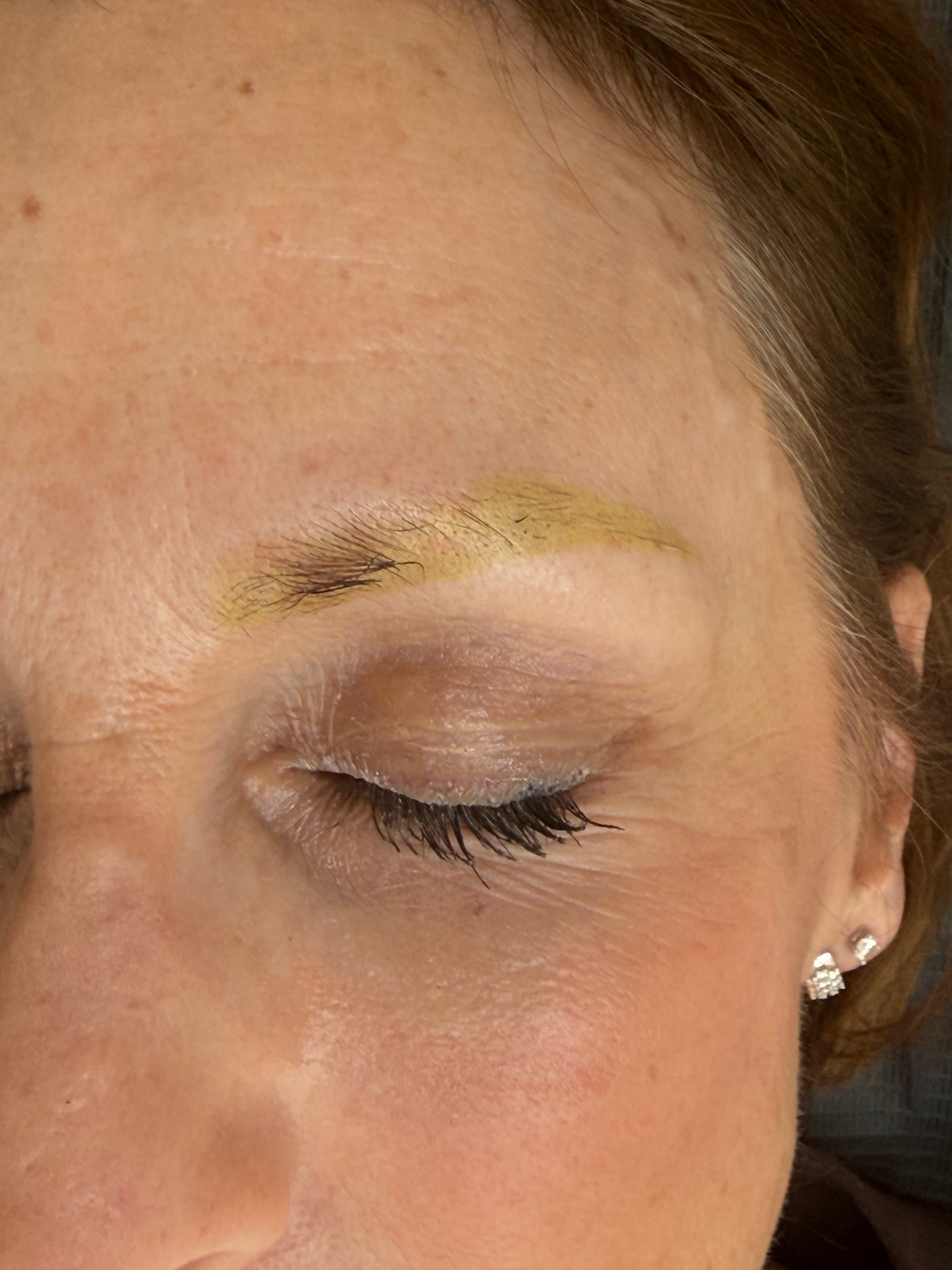
This article combines my clinical experience correcting laser-treated eyebrows with current pigment science and published pigment classifications. It is intended to help both clients and PMU professionals better understand why yellow residues may remain after laser removal.
Yellow residual pigment following laser removal is one of the most challenging situations in permanent makeup. In my practice I have seen clients who have undergone six, eight or even ten laser sessions, only to discover that their eyebrows no longer appear grey — but bright yellow.
Many artists ask: “Why does laser create yellow?” In my experience, the answer is more complex than most people realise. Several independent mechanisms may contribute simultaneously, and understanding them is essential before planning any corrective procedure.
The myth: “laser creates yellow”
One of the most widespread beliefs in PMU is that laser treatment turns pigment yellow. In my clinical observation, and based on the current scientific literature I review, this statement oversimplifies what happens. In many of the laser correction cases I have personally observed, a persistent yellow residue may remain after multiple laser sessions — but the mechanism is more complex than a single chemical reaction.
Instead, laser appears to change the balance between the pigment components that originally formed the brown eyebrow colour. The final yellow appearance is probably the result of multiple overlapping phenomena rather than one isolated event.
A brown eyebrow is never just brown
Permanent makeup pigments are mixtures. A typical eyebrow pigment may contain Carbon Black (CI 77266), Black Iron Oxide, Red Iron Oxide (CI 77491), Yellow Iron Oxide (CI 77492), organic yellow pigments, organic orange pigments, and — in some formulations — Titanium Dioxide (CI 77891).
Each ingredient behaves differently under laser energy. That is where the story of the yellow eyebrow really begins.
Laser does not remove every pigment equally
Laser treatment works because different pigments absorb different wavelengths of light. Carbon Black absorbs laser energy extremely efficiently. Many yellow pigments do not. In my observation, laser removal is therefore selective, not uniform.
After successive treatments: black disappears, dark brown fades, red components may decrease, and yellow components often become increasingly visible. In my clinical experience, the laser is not adding yellow — it is revealing a different balance of colours that was already present in the original pigment mixture.
But is that the whole story?
Probably not. Clinical observations suggest that selective removal alone does not explain every case. Many eyebrows I have seen follow a predictable sequence:
- Grey
- → Orange
- → Yellow
- → Almost fluorescent yellow
If only black pigment were disappearing, why would yellow continue becoming brighter after multiple laser sessions? This observation suggests additional mechanisms may also be involved.
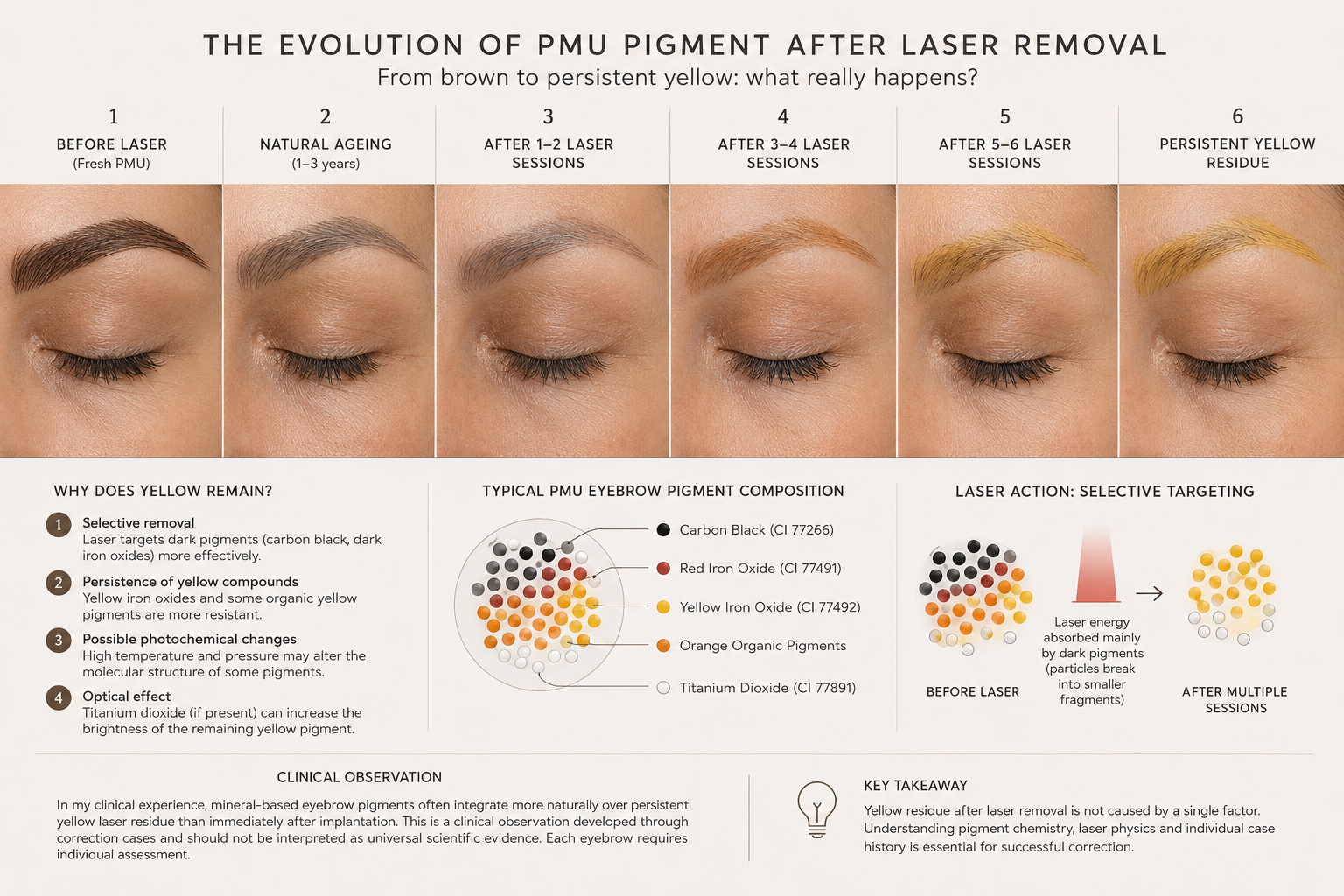
What I observe in my clinic
One of the most common questions I receive is why some eyebrows remain bright yellow after several laser sessions. In my experience, these cases behave very differently from traditional grey or red corrections.
The skin has often been through multiple laser cycles, which means it is not the same tissue that originally received the pigment. Texture, undertone, vascularisation and the remaining pigment particles all change. These are not theoretical details — they are what I assess before deciding whether, and how, to correct a brow.
Possible photochemical changes
Laser pulses expose pigment particles to enormous temperatures and pressures for only a few nanoseconds. Some pigments are known to change chemically after laser exposure — iron oxide darkening is a well-documented example.
Whether certain organic yellow or orange pigments undergo similar molecular changes after Q-switched or picosecond exposure remains uncertain. Further research is required before drawing firm conclusions.
The role of Titanium Dioxide
Titanium Dioxide is white — not yellow. However, it reflects light extremely efficiently. Once darker pigments have disappeared, Titanium Dioxide may increase the perceived brightness of the remaining yellow pigments. This optical effect could explain why some post-laser eyebrows appear almost fluorescent under natural light.
My current clinical approach
Every case is different, but when I work on laser-treated eyebrows with yellow residues I generally prefer mineral pigments because, in my clinical experience, they often heal in a more natural way on these difficult skin conditions.
When appropriate for the individual case, I select carefully chosen mineral-based pigments rather than formulations containing a higher proportion of bright organic yellow components. Mineral formulations are generally dominated by iron oxides and contain fewer highly saturated yellow organics.
In my experience, this often produces a healed result that blends more naturally with the underlying yellow residue. Immediately after treatment the eyebrows may appear slightly cooler than expected — but once healed, the final colour frequently becomes more harmonious than the fresh appearance initially suggests.
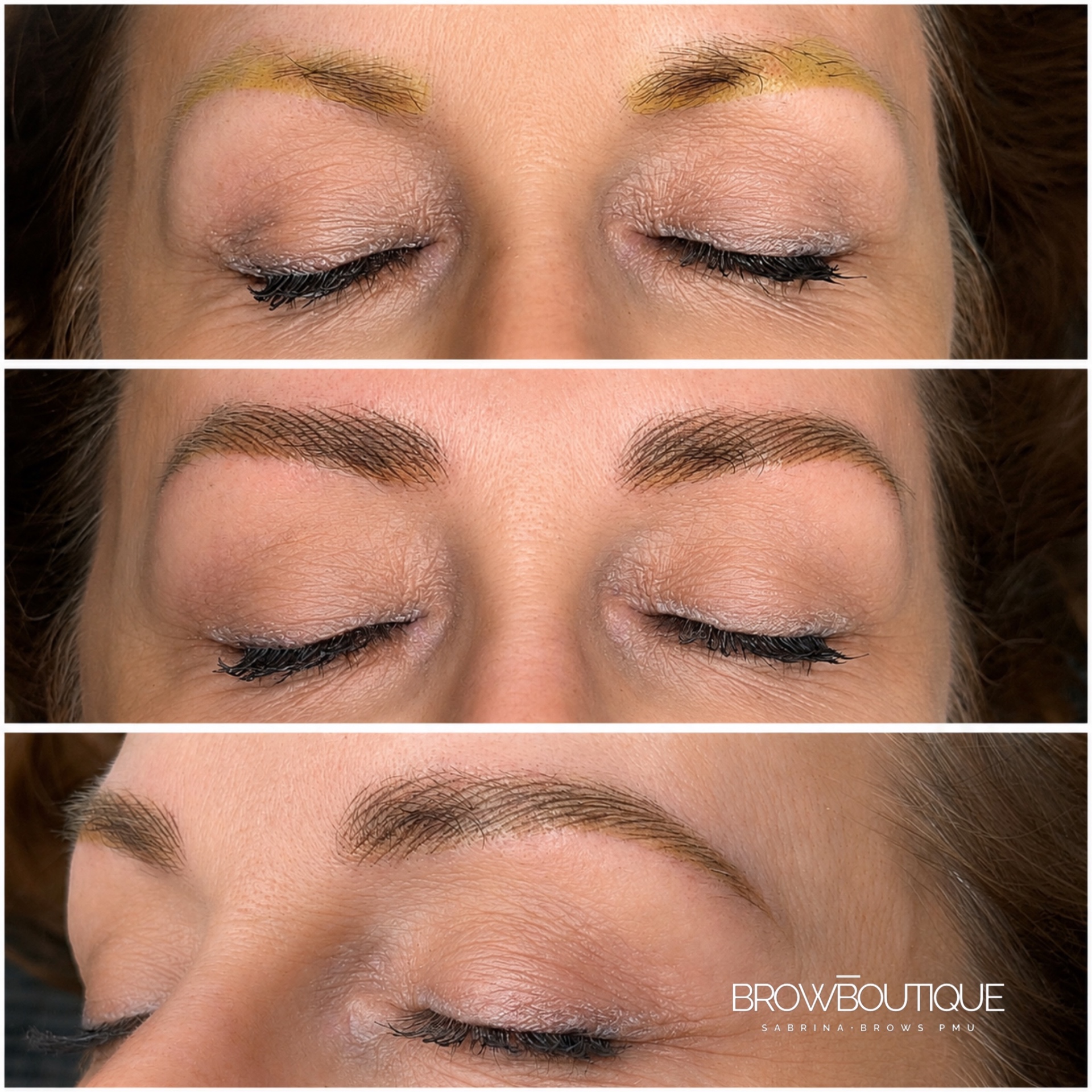
This is not a universal protocol. It is a clinical observation developed through practical experience with post-laser correction, and every patient requires an individual assessment based on original pigment history, laser history, skin characteristics, residual colour and healing behaviour.
Understanding pigment chemistry matters
Modern PMU artists increasingly need to understand more than colour theory. Knowledge of Colour Index (CI) numbers, pigment chemistry and light stability allows more predictable decision-making.
Different pigment classes have markedly different lightfastness and long-term behaviour, ranging from photoactive pigments with lower resistance to highly photostable compounds and inorganic iron oxides. (I explored this scale in detail in How long do permanent eyebrows really last?.) The future of permanent makeup correction will depend less on memorising colour recipes and more on understanding the science behind pigments.
Current scientific understanding
Based on current evidence, the most reasonable explanation is that post-laser yellow eyebrows result from several concurrent mechanisms:
- selective removal of darker pigments
- persistence of laser-resistant yellow compounds
- possible photochemical modifications of some pigments
- optical effects produced by Titanium Dioxide when present
Further research is needed before definitive conclusions can be reached — but this multi-factor view already explains far more clinical cases than any single-cause theory.
Final thoughts
Every laser correction tells the story of the pigment that was originally implanted. By understanding pigment chemistry rather than relying solely on colour wheels, PMU artists can make more informed decisions, reduce unnecessary procedures, and offer clients safer, more predictable long-term outcomes.
If you are living with a yellow residue after laser and considering correction, the most important first step is not a needle — it is an honest assessment. Book a consultation and we will look at your history, your skin and your options together.
This article will be updated as new clinical cases and pigment research become available.
Have questions about your brows?
Book a Consultation