8 May 2026 · 6 min read
Basic vs advanced microblading patterns: a side-by-side teaching demo
Most people booking microblading have no reference for what good actually looks like. Studios show freshly-done photos, prices vary wildly, and the technique sounds the same on every website. The truth is that microblading is a manual craft — and like any manual craft, the gap between a basic technical execution and advanced, Master-Associate work is enormous.
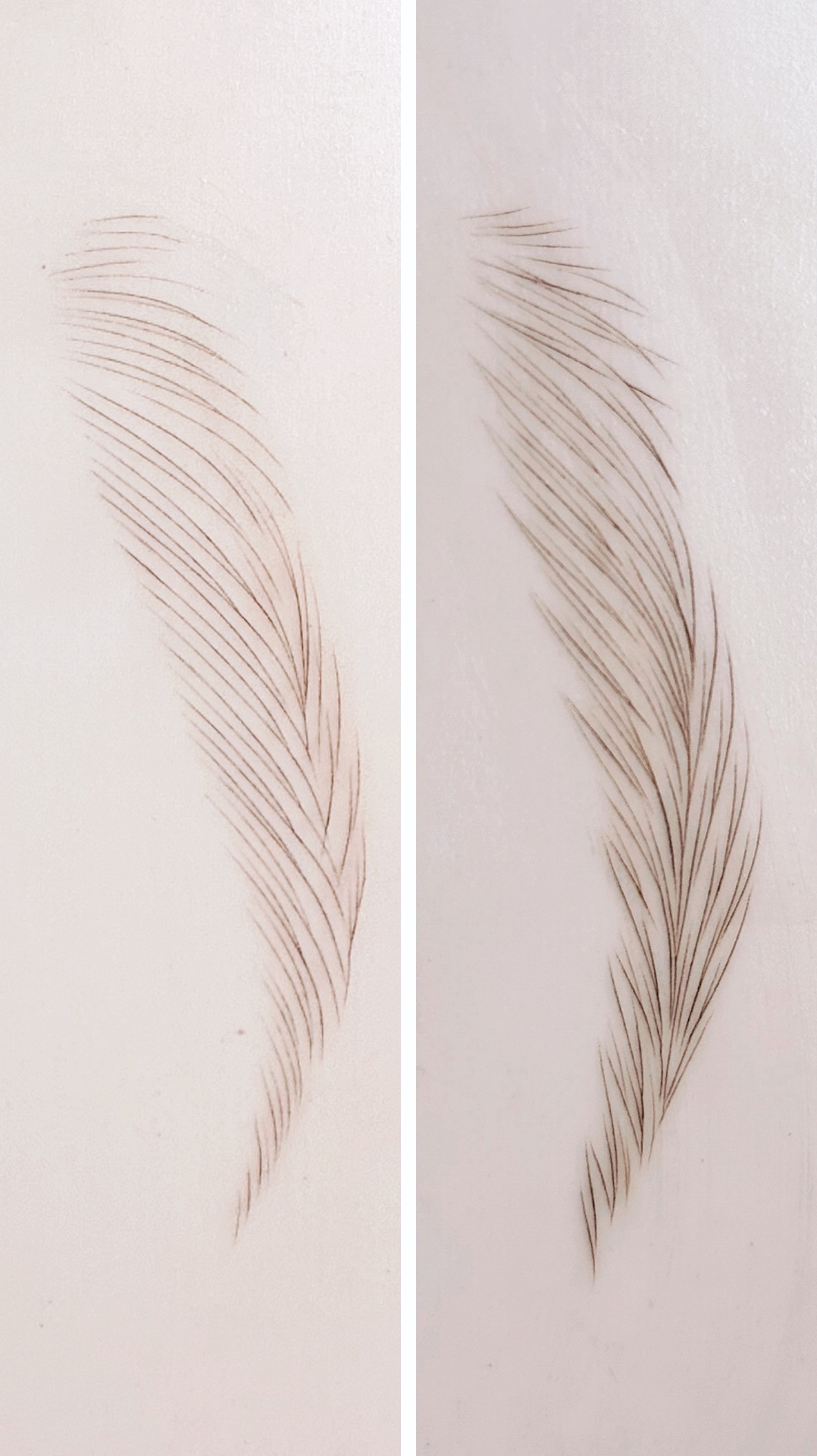
Below is a real comparison: two microblading patterns drawn on synthetic skin by the same artist. The left one is a deliberately basic-level pattern — the kind of execution you would see from a competent but not advanced practitioner. The right one is at advanced Master-Associate level. Same hand. Same tool. Same pigment. Different level of execution. We use this side-by-side as a teaching demo for our students and our clients.
What you are looking at
On the left, a basic-level pattern: visible strokes, a recognisable brow shape, no obvious mistakes at first glance. Acceptable, but not refined. On the right, an advanced pattern executed at Master-Associate standard.
Look at four specific things.
1. Direction and growth flow
Real eyebrow hair grows in a precise, fan-like flow: vertical at the head, sweeping diagonally across the body, then angling down through the tail. Basic-level work follows this loosely. Advanced work follows it stroke by stroke — every single hairstroke matches the underlying anatomical growth pattern.
On the right pattern, notice how the strokes fan out at the head, lay almost parallel through the body, then sweep cleanly into the tail. On the left, the direction is approximate.
2. Stroke length and taper
Each microblading stroke should taper — start thin, fatten slightly, finish thin again. This is what makes it read as a hair instead of a line. Strokes should also vary in length: shorter at the edges, longer through the body, never uniform.
Basic microblading shows strokes of similar length and weight. Advanced work shows controlled variation — the kind of irregular precision that mimics nature.
3. Density and negative space
Healed brows need gaps. Negative space between strokes is what stops the brow from healing as a solid block. Basic work tends to either over-pack strokes (which blur into a shadow within months) or under-pack them (which heals patchy).
Advanced work spaces strokes deliberately, with denser zones at the body and tail and lighter zones at the head and around the arch.
4. Depth consistency
This one you cannot see in a photo, but it shows up in the healed result. Microblading must be performed at a precise depth — too shallow and the pigment falls out, too deep and it scars and blurs. Master-level training is mostly about teaching the hand to hold this depth across hundreds of strokes without variation.
Inconsistent depth is the single biggest reason microblading heals badly six months later, and it is the single hardest thing to learn.
Why this matters before you book
Microblading is permanent on your face for 12–18 months and visible for longer. The cost of choosing badly is not just the appointment fee — it is a year of looking at brows you do not love, plus the cost of correction or removal afterwards.
When you consult any studio, ask to see:
- A practice pattern on synthetic skin (this reveals raw technique without the help of anaesthetic, lighting or filters)
- Healed photos at 30 days and at one year — not freshly-done shots
- Certification: PhiBrows Artist, Royal Artist or Master Associate are the recognised tiers
- Healed work on skin similar to yours
Our standard
Sabrina Zanin is a Phi Academy Master Associate — the senior teaching tier within the Phi system. Every brow at Browboutique is performed at the standard you see on the right of this comparison, and every consultation is honest: if your skin is not suited to microblading, we recommend Breath Brows™ instead.
There is no shortcut to advanced work. There is also no substitute for it.
Have questions about your brows?
Book a Consultation